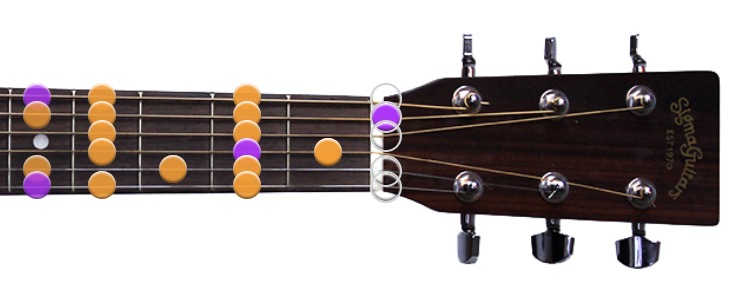
Guitar scales are groups of musical notes played in a specific order, usually ascending or descending. They are the foundation of melodies, solos, riffs, and improvisation. If you want to understand the guitar fretboard, play cleaner solos, or create your own melodies, learning scales is one of the best places to start.
A guitar scale helps you know which notes sound good together in a specific key. For example, the C major scale uses the notes C, D, E, F, G, A, B, and C. Once you understand that pattern on the fretboard, you can use it to build melodies, understand chords, and move more confidently around the guitar neck.
Practicing scales on guitar also improves finger strength, coordination, picking accuracy, and musical ear. Even a few minutes of slow scale practice every day can help you play cleaner notes and understand how songs are built.
How to Play Scales on Guitar
To play a scale on guitar, first choose a key, such as A, C, D, or G. The key tells you which note the scale starts from and which notes belong to that scale.
Next, choose the type of scale you want to practice. The most common guitar scales for beginners are the major scale and the minor scale. Major scales usually sound bright, happy, and open. Minor scales often sound deeper, sadder, or more emotional.
Once you select the key and scale type, follow the notes shown on the guitar fretboard diagram. Start slowly, play each note clearly, and pay attention to the root note, because that note gives the scale its name.
Why Guitar Scales Are Important
Scales help guitar players understand how music works. They show the relationship between notes, chords, and melodies. When you practice scales, you are not only training your fingers, you are also training your ear.
Learning guitar scales can help you:
- Play solos and lead guitar parts
- Create melodies over chord progressions
- Understand how chords are built
- Improve finger movement and picking control
- Learn the guitar fretboard faster
- Improvise with more confidence
If you are a beginner, do not worry about playing fast. The goal is to play cleanly and understand where the notes are. Speed comes later.
Major Scales for Guitar
The major scale is one of the most important scales in music. It has a bright and familiar sound, and many songs are built from major scale patterns.
For beginners, the major scale is a great starting point because it helps you understand the basic structure of keys, chords, and melodies. Once you learn a few major scales on guitar, you will begin to see how notes connect across the fretboard.
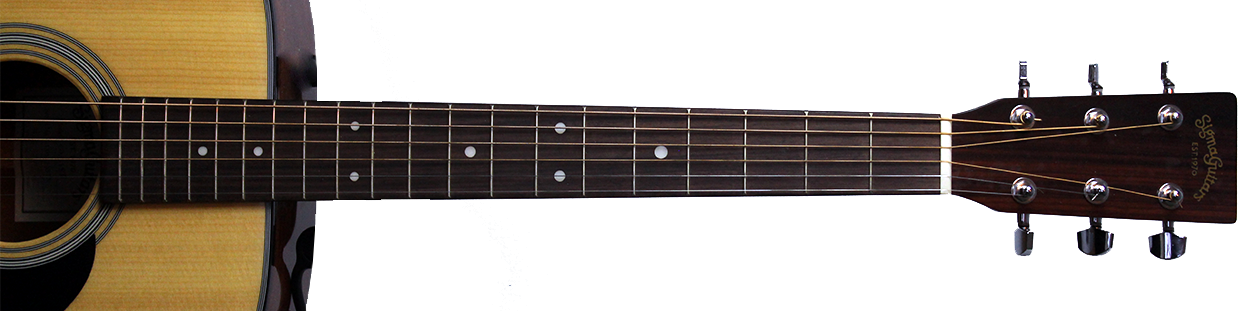
All major scales for Guitar are shown below. Grab your guitar and play the notes slowly on each fretboard diagram. The highlighted root note shows the key of each scale, so you can always return to the home note of the scale.
A Major Scale on Guitar
A major
B Major Scale on Guitar
B major
C Major Scale on Guitar
C major
D Major Scale on Guitar
D major
E Major Scale on Guitar
E major
F Major Scale on Guitar
F major
G Major Scale on Guitar
G major
Minor Scales for Guitar
Minor scales are just as important as major scales. They are used in rock, blues, pop, metal, folk, Latin music, and many other styles. If you want to play emotional melodies or expressive solos, minor scales are essential.
A minor scale changes the feeling of the music. Compared with the major scale, the minor scale has a different third note, which gives it that darker and more emotional sound.
It is helpful to learn major scales first, but it is not required. Many guitar players begin with minor scales because they are common in solos, riffs, and improvisation. The important thing is to practice slowly and listen carefully to the sound of each scale.
Now grab your Guitar again and start practicing the minor scales below.
A Minor Scale on Guitar
A minor
B Minor Scale on Guitar
B minor
C Minor Scale on Guitar
C minor
D Minor Scale on Guitar
D minor
E Minor Scale on Guitar
E minor
F Minor Scale on Guitar
F minor
G Minor Scale on Guitar
G minor
How to Practice Guitar Scales
The best way to practice guitar scales is slowly and consistently. Start with one scale, such as C major or A minor, and play it up and down the fretboard until the movement feels natural.
Use these simple practice tips:
- Play each note slowly and clearly
- Keep your fingers close to the fretboard
- Use alternate picking if you are practicing with a pick
- Say the note names out loud when possible
- Practice with a metronome
- Start slow before increasing speed
- Try creating short melodies with the notes of the scale
Do not practice scales only as an exercise. After playing the notes in order, try to make music with them. Repeat a few notes, change the rhythm, skip notes, and create small phrases. This helps you move from memorizing patterns to actually playing music.
What Guitar Scale Should a Beginner Learn First?
A beginner can start with the C major scale or the A minor scale. C major is useful because it has no sharps or flats, making it easier to understand. A minor is also a great starting point because it shares the same notes as C major and is very common in guitar music.
Once you feel comfortable, practice the same scale in different keys. This will help you understand the guitar neck instead of memorizing only one shape.
Final Thoughts
Guitar scales are one of the most valuable tools for any guitarist. They help you understand the fretboard, improve your technique, build melodies, and play solos with confidence.
Take your time. Play slowly, listen to each note, and let your fingers discover the map of the fretboard. Little by little, scales stop feeling like exercises and start becoming music.