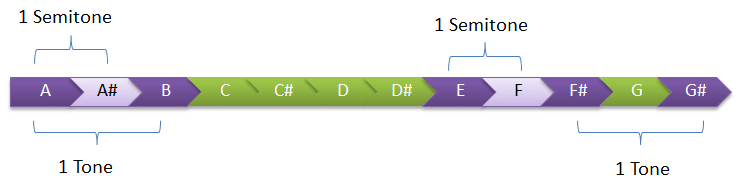
On the Venezuelan cuatro, a natural note is a pitch with no sharp or flat in the name: A, B, C, D, E, F, G. The fingerboard is those seven names, repeating, with a half-step or a whole-step between each pair. Once you can see that grid, every scale and chord later is just a shape on top of it.
Tone and semitone, in the hand
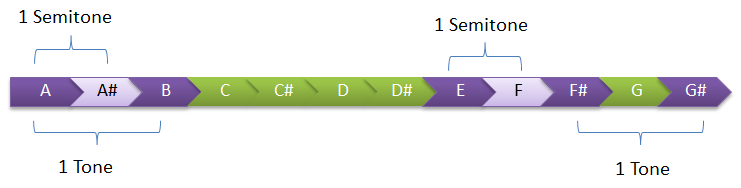
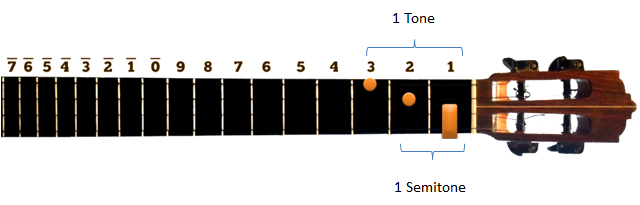
A semitone (half step) is one fret. A tone (whole step) is two frets. That is the whole measuring system.
From B to C is a semitone. From E to F is a semitone. Every other pair of natural notes is a tone. That is why the piano has no black key between B-C and E-F, and why your cuatro has only one fret between those same letters.
The same distances on one string
Pick any string. The open note is your starting letter. Two frets up is a tone. One fret up is a semitone. Walk the natural notes on the first string (open B) and you get:
- Open: B
- 1st fret: C (semitone)
- 3rd fret: D (tone)
- 5th fret: E (tone)
- 6th fret: F (semitone)
- 8th fret: G (tone)
- 10th fret: A (tone)
- 12th fret: B again (tone). The octave.
Do the same walk on the other three strings, starting from A, D, and F♯. The letters change. The tone / semitone pattern does not.
Why this matters before chords
A G major chord is three specific natural notes sounding together: G, B, and D. If you cannot find G, B, and D on the neck, you are memorizing a photograph. If you can find them, you can move the photograph.
Same for a melody. The first phrase of almost every vals you will learn is a path across these seven letters. Sharps and flats come after, as alterations of a letter you already own.
A ten-minute drill
- Tune to A D F♯ B. If that is still shaky, start with how to tune the cuatro.
- Say the seven letters out loud, in order, twice: A B C D E F G.
- On the first string only, play every natural note from open B up to the 12th fret. Name it before you play it.
- Repeat on the fourth string, from open A.
When you can do that without looking at a chart, you are ready for chord shapes.
What to do next
Keep going. Free, and with a teacher if you want one.
The full natural-notes lesson, with video and the lessons around it, is inside the free course. Create an account and pick up there. If you want someone listening while you walk the neck, book a live class.
Create a free account Book a live class WhatsApp us
Or leave your email and we will send the next step.
Or call +1 (613) 416-3412.